Just as a Roman patrician had to move through a strict sequence of offices before reaching the consulship, the modern American grifter must climb a highly legible ladder of monetizable honors. What looks like ideological conviction from a distance often turns out, at closer range, to be a career track with its own entry rites, spectacles, treasury offices, and ceremonial exits.
Origin
Outrage as service record
The first credential is not competence but injury. A grifter needs a founding wound, preferably public, screenshot-friendly, and endlessly reusable.
Treasury
Audience to revenue
Once the crowd has assembled, the task is to convert indignation into subscriptions, supplements, branded coffee, and recurring charges.
Consummation
Campaign without office
The ideal political run is one that loses profitably. Office is work; candidacy is infrastructure, lists, and donor cash.
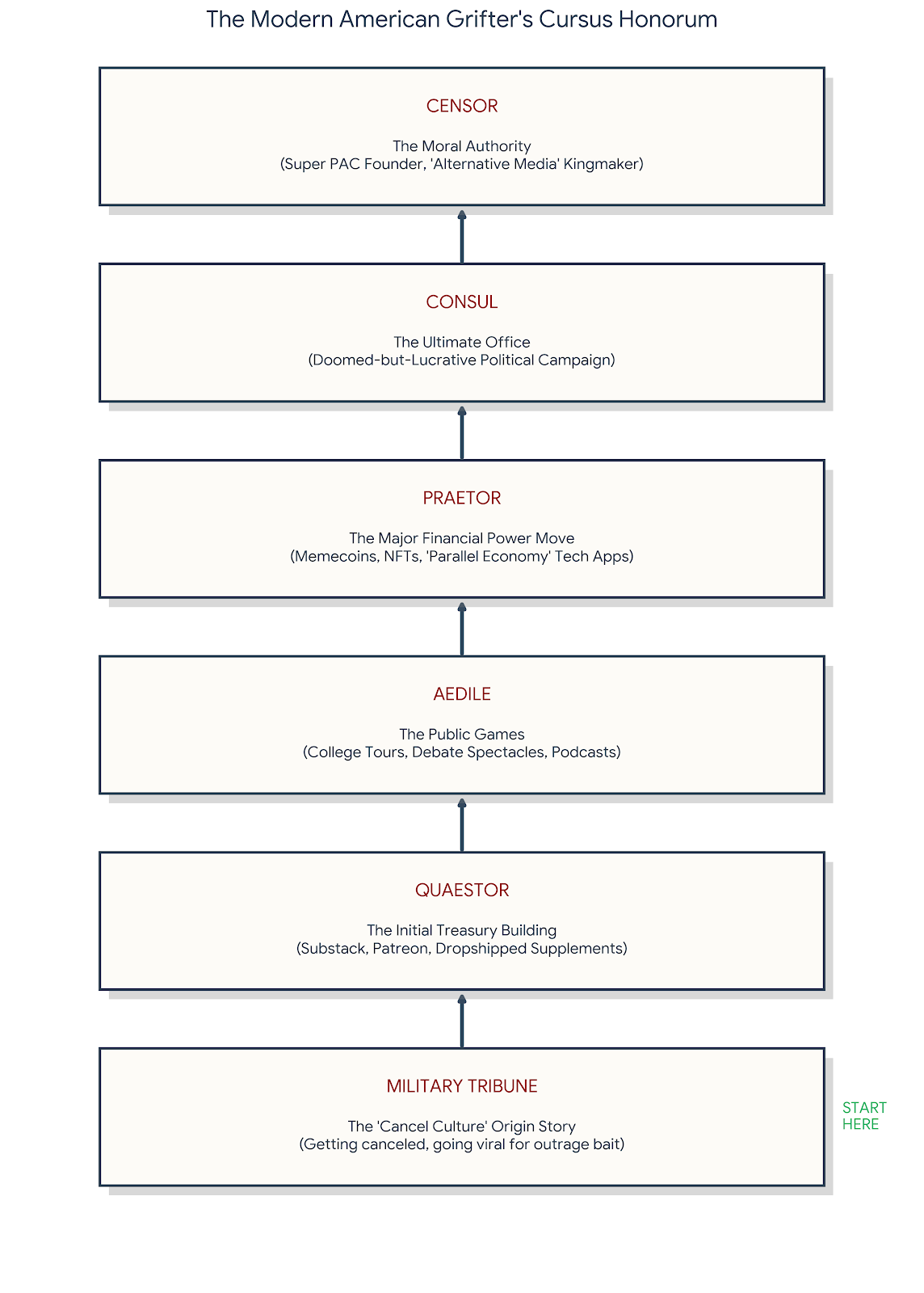
The grifter does not rise by disproving the system. The grifter rises by persuading followers that every new monetization scheme is another heroic battle against it.
Thread thesis
1. Military Tribune: The Cancel Culture Origin Story
Before entering formal politics, young Romans were expected to serve in the military and prove their mettle. The contemporary equivalent is the public cancellation, firing, deplatforming, or viral outrage incident that becomes a grifter's foundational myth. This is the tour of duty. It establishes that they have suffered in the trenches of the culture war.
The details hardly matter so long as the event can be retold as persecution. A disastrous tweet, a campus protest, an HR complaint, a network firing: all can be polished into the same biography. The point is not truth but credentialing. The future grifter must first be certified as the kind of person whom elites tried to silence.
2. Quaestor: The Initial Treasury Building
In the Roman Republic, the quaestor was the entry-level magistrate charged with the treasury. In the modern version, this is the Substack, Patreon, or supplement phase. The audience has already been assembled by outrage, but outrage alone is not a business model until it becomes cash flow.
This is where premium newsletters warning of civilizational collapse appear, where brain pills are introduced as patriotic duty, and where coffee acquires ideological branding. The quaestorship does not yet require grandeur. It only requires proof that followers can be converted into recurring revenue.
3. Aedile: The Public Games
Roman aediles won favor by staging festivals and games. The modern grifter does the same thing through spectacle. A podcast, a college tour, a neon sign, a combative stage persona, and a camera pointed at nineteen-year-olds become the new gladiatorial circuit.
This phase exists because ideology without entertainment cannot scale. Clips must be harvested, titles must be sharpened, and the audience must be fed blood sport in digestible algorithmic portions. The aedile learns that the mob does not merely want doctrine; it wants theatrical victory.
4. Praetor: The Major Financial Power Move
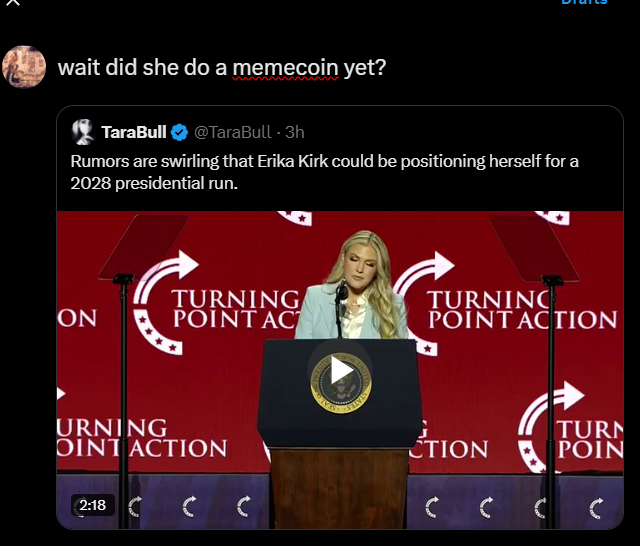
By the praetorian stage, the grifter has enough authority to attempt the major liquidity event. In Roman terms this is the jump into higher office and larger jurisdictions. In contemporary terms it is the memecoin, the NFT drop, the parallel-economy app, or the free-speech platform destined to vanish as soon as the founder has extracted what matters.
The audience has now been trained to mistake participation for loyalty. To buy the token is to join the cause. To buy the NFT is to defend civilization. To move onto the new platform is to resist censorship. The rhetoric is liberation; the mechanism is extraction.
5. Consul: The Doomed-but-Lucrative Campaign
The Roman consulship was the highest regular office of the Republic. Its contemporary analogue is the congressional or presidential campaign that everyone involved should privately hope will fail. Actually governing is a poor business model. Campaigning, by contrast, opens the national fundraising apparatus, yields donor lists, and permits the bulk purchase of one's own ghostwritten book by one's own committee.
The candidate now speaks as if burdened by destiny. But the real office being sought is not legislative. It is infrastructural: the right to convert followers into donors and donors into portable political capital. Losing nobly is often far more profitable than winning awkwardly.
6. Censor: Moral Authority After the Campaign
After the consulship, a prestigious Roman might become censor, charged with public morality and civic classification. The modern grifter's version is the post-campaign ascent into kingmaking. This is the Super PAC phase, the founder-of-alternative-media phase, the moment when the former candidate no longer begs the crowd for office but judges which younger aspirants are worthy of it.
From this higher perch, the mature grifter casts down verdicts on authenticity, betrayal, and ideological purity. Dark money is routed. New entrants are blessed or excommunicated. The figure who once built a career on persecution now sits above the fray, guarding the gates of the next generation's quaestors.
That is why the cursus holds. Every stage prepares the next: injury leads to audience, audience to revenue, revenue to spectacle, spectacle to speculation, speculation to candidacy, and candidacy to moral authority. The grifter does not escape politics. The grifter perfects its ceremonial shell while hollowing out its administrative core.
Thread Notes
The Roman cursus honorum supplies the satirical frame: a ladder of offices through which ambition is formalized and made legible.
The comparison works because both systems depend on sequence. No stage makes sense unless the previous one has already created the necessary prestige or liquidity.
The joke turns serious at the campaign phase: a political culture built around monetized grievance makes losing office more rewarding than holding it.