The Bull Corridor is not just a route of exchange. It is a route of images, rites, and political succession. Ships, garlands, rings, and harbor names move through it; so do myths about who has the right to inherit the sea. Gregory Nagy's work on Diachronic Homer helps make that visible. His argument suggests that the Minoan world, the Mycenaean takeover of Crete, and the later Athenian memory of Minos all belong to one long history of ritualized marine power.
Gesture
Garlanding
A garland is not an ornament added at the end. It is the act that frames the vessel, the rite, and the voyage as sacred and complete.
Transfer
Ring and inheritance
Theseus and Minos are not only mythic figures. They stage a political transfer of sea-power through a ritual test in water.
Language
Imperial plurals
Names like Athene and Athenai show how a center can expand linguistically into the territory, people, and hinterland that belong to it.
To garland the ship, cast the ring, or name the city in the plural is to do more than describe power. It is to place power inside a ritual frame.
Thread thesis
Garlands and Framing
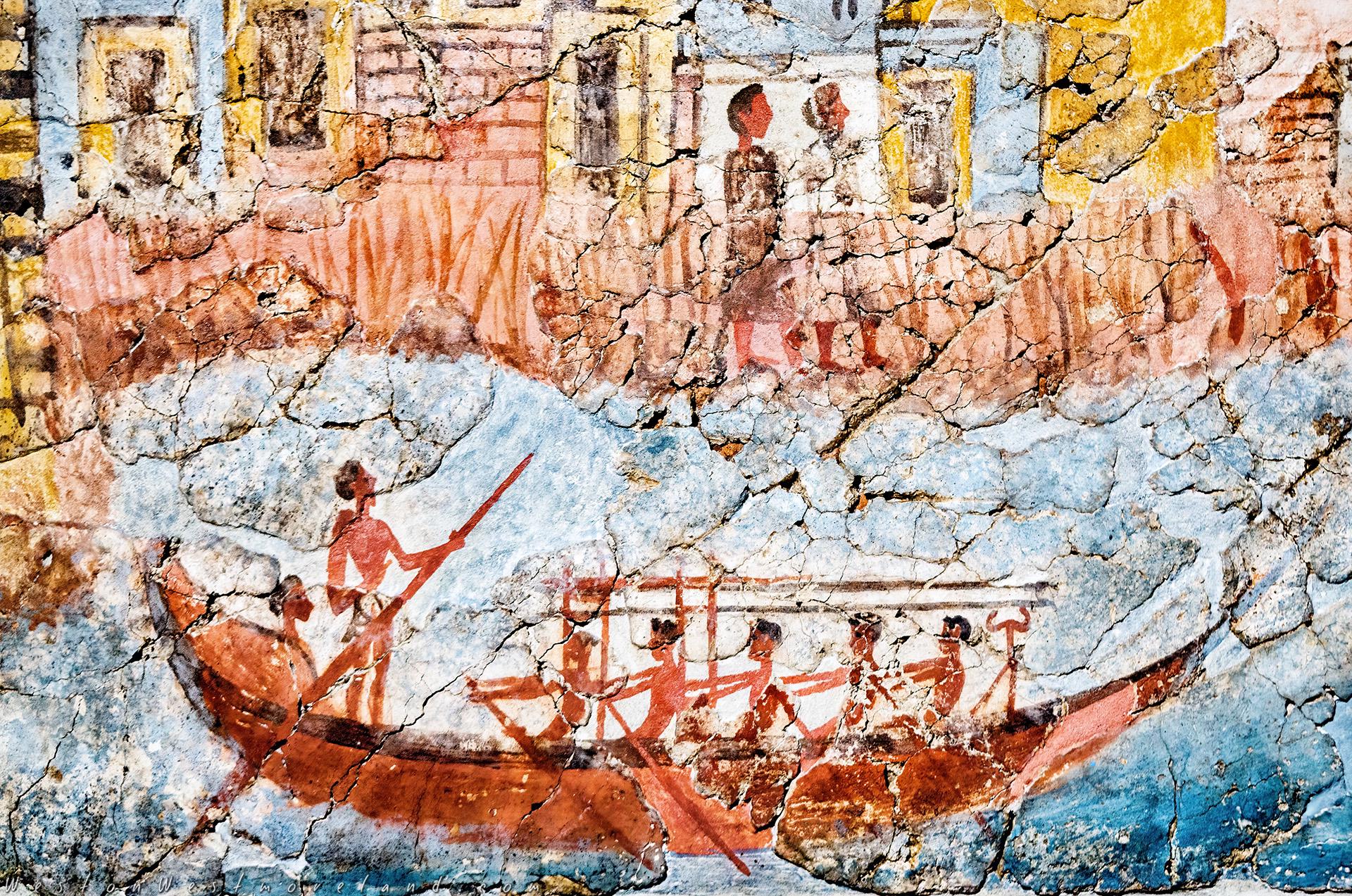
Nagy's closing move in the flotilla argument is to tighten the role of the garland. In the Akrotiri miniature, the stern-cabins of the great ships are decorated with semicircular flower garlands. In the adjacent West House room, similar garland-forms frame a view. The effect is not casual decoration. The eye is being taught to look through a floral threshold.
That matters because the garland marks the moment when ordinary space becomes ritual space. A framed ship is no longer just a vehicle. A framed opening is no longer just a view. The garland tells the viewer that a threshold has been crossed and that the scene now belongs to a ceremonial order.
Marrying the Sea
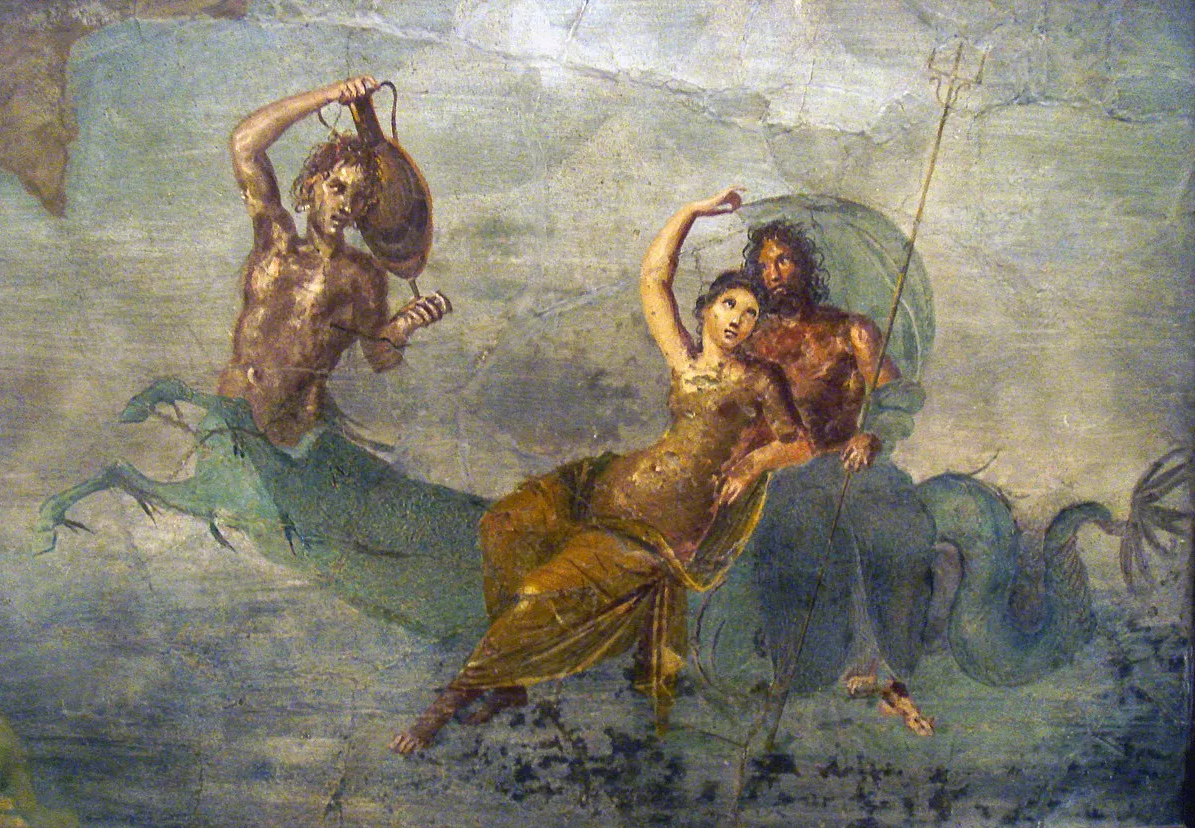
Nagy connects the Akrotiri garlands with Bacchylides 17, where Theseus dives into the sea and Amphitrite gives him a garland of roses. That gift inaugurates her marriage to Poseidon and, at the same time, marks Theseus as the god's son. The garland is therefore not simply floral. It is juridical, dynastic, and marine all at once.
Modern Greek tamata with paired wedding garlands preserve the same underlying logic. The wreath attached to a person, a ship, or a sacred image marks the perfect beginning of the rite. It says that the voyage, the marriage, or the annual cycle has now formally begun. In that sense, garlanding the ship is parallel to the Venetian ring cast into the Adriatic: both are acts of marrying the community to the sea.
The Athenian Connection
From there Nagy returns to the Mycenaean takeover of Crete and sharpens the political implication. The room of the chariot tablets at Knossos records the distribution of chariots, horses, and armor to a Greek-speaking military elite, the Akhaioi. His provocative suggestion is that some of these Akhaioi may have been specifically Athenians rather than only generic Mycenaeans.
On that reading, the Theseus-Minos-ring myth becomes an aetiology of transfer. Theseus dives, retrieves Minos's ring from the sea, and proves Athenian worthiness to inherit the sea-empire. The older Minoan thalassocracy is ritually handed over to an emergent Athenian thalassocracy long before Classical historians make the pattern explicit. Myths of Minos, Ariadne, and the ring are therefore not late fantasy alone; they preserve a memory of succession.
Imperial Plurals and Corridor Language
Nagy's linguistic coda is especially useful for corridor work. He defines an elliptic plural: a singular names the person or place itself, while the plural names the place plus everything that belongs to it. Athene can become Athenai; Aswia can open into Asia. The plural is not merely grammatical. It is territorial.
That matters because corridor hubs rarely stand alone. A name can designate a node and its hinterland at once. The city, its harbor, its countryside, and its sphere of control collapse into one linguistic form. Once this is noticed, some Homeric and eastern Mediterranean place-names begin to look less like simple points on a map and more like compressed statements of imperial reach.
The Bull Corridor, then, is not only a line between places. It is a way of seeing how image, rite, myth, and naming practices travel together. Garlands frame the ship; rings certify inheritance; plurals expand the city into the region it rules. What emerges is a marine order in which power is always staged, always remembered, and often inherited through ritual action.
Thread Notes
Gregory Nagy, Diachronic Homer and a Cretan Odyssey. This thread extends the paper's treatment of garlands, the Athenian connection, and imperial plurals into a broader corridor argument.
Bacchylides 17 supplies the crucial marine gift scene: Amphitrite's garland turns sea-descent into dynastic recognition and ritual legitimacy.
The corridor model used here treats hubs not as isolated points but as centers plus hinterlands, making Nagy's elliptic plural especially useful.