Nagy begins with a useful distinction. A synchronic view catches a structure at a given moment; a diachronic view follows that structure as it changes, survives, and remembers itself. Homeric poetry, on this reading, is not a fixed monument but an evolving medium. That is why the Odyssey's Cretan tales matter: they preserve a late verbal witness to an older world of sea-power, ritual transfer, and imperial imagination.
Method
Diachrony plus iconography
The Clew reads Homeric language and Aegean images as different witnesses to one structural world, rather than forcing one to illustrate the other directly.
Backdrop
Thalassocracy as constant
Minoan and then Mycenaean sea-order form the political atmosphere behind flotilla scenes, harbor names, and myths of inheritance.
Threshold
Ring and garland
Ritual gifts to the sea and ritual decoration of ships are not ornament. They are activating gestures that switch on the civic rite.
Read together, diachronic Homer and synchronic iconography reveal the same deep structure in different media. The Odyssey's Cretan tales and later language of thalassocracy become verbal witnesses to the world encoded in flotilla imagery, framed thresholds, and ritual marriage to the sea.
Thread thesis
Method Frame
This is the cleanest way to differentiate The Clew from Home. Home remains the long-form interactive laboratory where arguments unfold in public. The Clew becomes the curated dossier layer: fewer moving parts, sharper cards, richer figures, and tighter typological framing. Here the point is not to animate every claim but to show how a set of claims belong together.
Nagy's insistence that myth must be read through ritual aligns perfectly with the Window / Threshold / Cella method already emerging elsewhere on the site. Flotilla and facade belong to Window. Ring-casting, border-running, and garlanding belong to Threshold. The underlying sea-imperial order belongs to Cella.
Minoan and Mycenaean “Empires”
Nagy keeps the contrast crisp. The Minoan thalassocracy of roughly 1700-1450 BCE is sea-based power centered on Crete, with Minos as the exemplary sea-king and place-names like Minoa preserving the memory of outposts of Minos. Classical writers such as Thucydides and Herodotus later use this Cretan model to think Athenian sea-power.
The Mycenaean sphere is different in center of gravity but no less maritime than it first appears. Its prestige core is the Peloponnese, especially Mycenae, yet it also stands as a seafaring rival to the Hittite world. Ahhiyawa can be read as the land of the Akhaioi, and Linear B becomes the bureaucratic language of that rival system.
Takeover and Fusion
The real historical movement is succession. Minoan sea-power is eventually taken over by Mycenaean elites, but not through simple rupture. Nagy stresses continuity in administration: temporary clay tablets, more permanent sealed records, and the reuse of earlier palace systems under new political control.
The room of the chariot tablets at Knossos is therefore emblematic. A former Minoan palace becomes a Mycenaean military and bureaucratic node. It is precisely the kind of political and ritual handover that appears again and again across the Crete-Cyclades-Anatolia-Syria corridor.
Myth and Ritual Interlock
Before he turns to Akrotiri, Nagy lays down the decisive principle: myth cannot be understood apart from ritual. Myth is the saying-side of sacred practice. Ritual often does not narrate its myth openly, but institutions still generate aetiologies, and those stories are the verbal face of the rite. Once that point is accepted, flotilla scenes stop being harmless marine genre and begin to look like ritual images.
Venice as Typological Comparandum
Nagy's Venetian detour is not decorative scholarship. In the Sposalizio del Mare, the doge boards the Bucintoro, leads a ritual flotilla from the basin of San Marco toward the Lido, and casts a golden ring into the sea. Venice marries the Adriatic. Prosperity, sovereignty, and marine destiny are staged as a public rite.
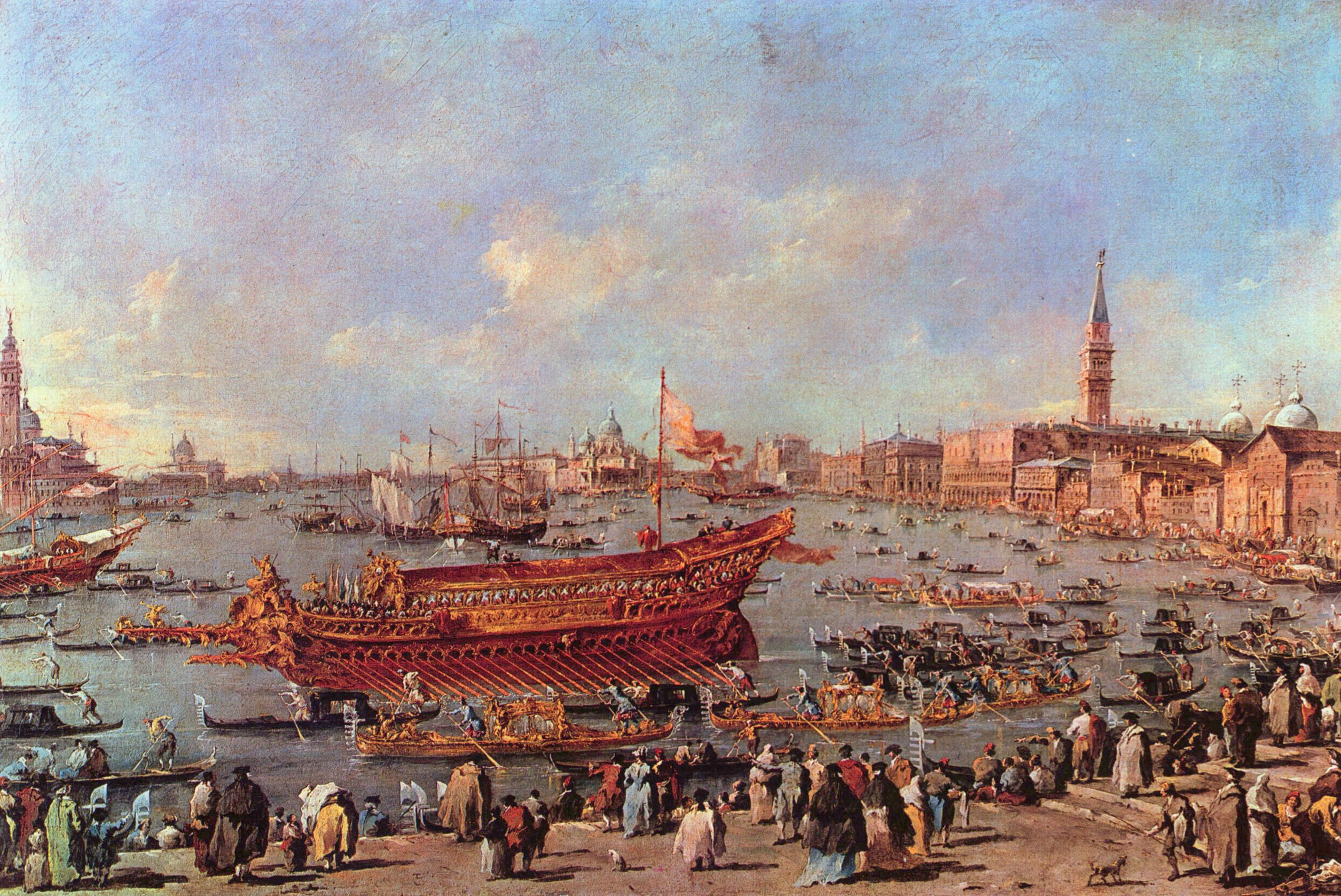
The Cervia version sharpens the exchange logic. A ring is thrown, divers retrieve it, and failure is ominous for farmers and fishers alike. The ring is “really” the sea's. Each year the community offers a new one, and the sea returns serenity and abundance. Nagy's gloss is memorable because it is so blunt: a finders-keepers mentality embedded in ritual.
Toward Akrotiri
Only once the Venetian logic is clear does Akrotiri come back into focus. The comparison is typological, not genealogical, but both image-worlds display a sea-polity through ritual parade. Ordered ships, framed stern-cabins, and marine procession communicate prosperity, power, and prestige.

Here the paper becomes especially revealing. The Odyssey's Cretan lies and later language of thalassocracy become verbal witnesses to the same structural world encoded here in paint. Not the same event, and not a straightforward illustration, but the same deep world seen through different media.
Garlanding as the Threshold Gesture
Nagy's most useful tightening move comes with garlands. In the Akrotiri miniature, the stern-cabins of the large ships are decorated with semicircular flower garlands. In the adjacent West House room, those same forms frame a view. We are literally looking through a floral threshold.
He then links this with Bacchylides 17, where Theseus dives and Amphitrite gives him a garland of roses, inaugurating her marriage to Poseidon and marking Theseus as the god's son. Modern Greek tamata with paired wedding garlands preserve the same logic. To garland a ship or object is to switch on the rite. The gesture marks a perfect beginning: the voyage and the year begin now.
The Athenian Connection
Nagy returns from ritual image to political succession. The room of the chariot tablets at Knossos points to a Greek-speaking military elite, the Akhaioi. His sharper suggestion is that some of these were specifically Athenians. On that reading, the Theseus-Minos-ring myth is an aetiology of transfer: Theseus dives, retrieves Minos's ring from the sea, and proves Athenian worthiness to inherit the sea-empire.
The older Minoan thalassocracy is therefore ritually handed to an emergent Athenian one long before Herodotus or Thucydides make the pattern explicit. Myths about Minos, Ariadne, and the ring may already be Mycenaean-period myths of inheritance.
Imperial Plurals and Corridor Language
Nagy's linguistic coda is especially useful for corridor work. He defines an elliptic plural: a singular names the person or place itself, while the plural names the place plus everything that belongs to it. Thus Athene can become Athenai, and similarly Aswia can open into Asia. The plural is not merely grammatical. It is territorial.
This gives readers an elegant way to understand maps, harbor-lists, and Homeric toponyms. Some names may preserve imperial horizon language rather than simple geography. They name a center and everything it rules. The Cretan Odyssey, the flotilla image, the sea-marriage rite, and the imperial plural all belong to one thread of thought.
Thread Notes
Gregory Nagy, Diachronic Homer and a Cretan Odyssey. This thread follows the paper's movement from method to thalassocracy, from ritual typology to Akrotiri, and from ring-transfer to imperial plurals.
The Venetian comparandum is typological, not genealogical. Its value is heuristic: it teaches us how a flotilla can visualize marine dominion, prosperity, and civic legitimacy without requiring direct descent.
One way to read the sequence is as image, activating gesture, and underlying order: flotilla image, threshold action, and the deeper imperial structure behind both.